NerdX
The voice science bit
I'll let you into a secret. Alex Owen-Hill and The Clown Professor, are the same person… shocking!
The Clown Professor is my egotistical alter ego who thinks he knows everything and is based on the fact that I'm an incurable academic. I have a PhD in robotics, from a previous life, and I'm currently doing an MA in Voice.
I'm also a professional voice coach and I'm currently doing applied voice research into topics like neurodivergent masking and voice, character voice pedagogy, voice for street performance, and clown-through-voice.
Here are a few of the voice concepts that we introduced in the talk. Some are from voice science, most are from my specific approach to voice pedagogy.
1. Shakespearean Acting Student
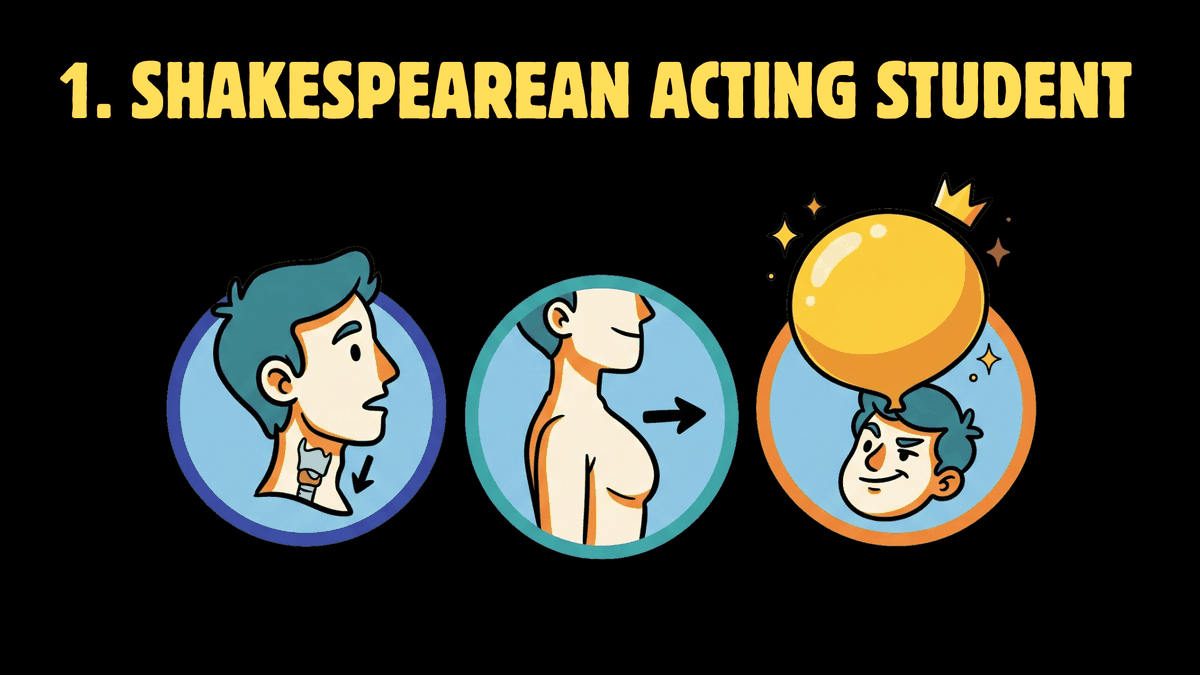
- The larynx is lowered — This relates to vocal qualities such as those in the Estill teaching method. Lower larynxes are often associated with a richer, rounder sound, such as in an operatic sob singing style or some stereotypical Shakespearean acting.
- The chest is pushed forward — Posture has a huge effect on the voice and pushing out of the chest can create what looks like a confident posture and resulting voice. The energy is often unbalanced. A more neutral posture is actually stronger and more confident.
- The ego is inflated by at least 45% — This is a made-up statistic but the idea of the ego being inflated relates to what voice coach Patsy Rodenburg calls “third circle energy.” This is energy that the performer projects over the audience, or through, them rather than the more balanced second circle energy, where the performance is a conversation between the audience and the speaker.
2. Shy & Uncertain
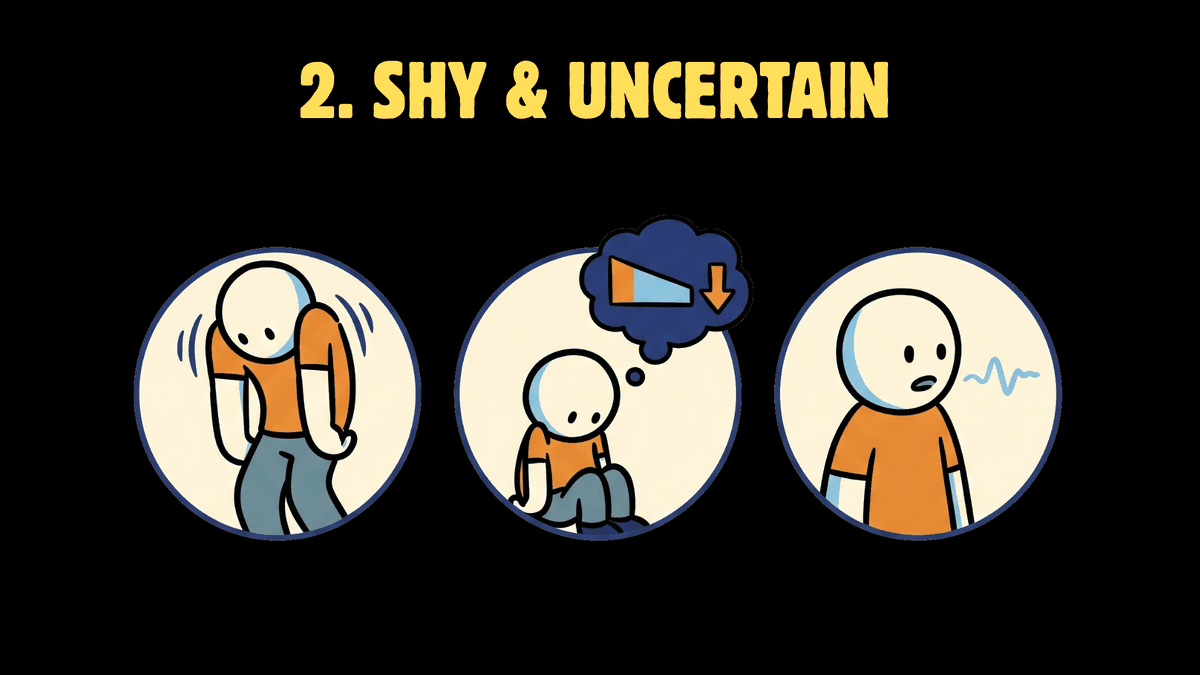
- The shoulders are hunched — Collapsing of the posture has an almost immediate effect on the voice so hunching of the shoulders and body reduces the amount of vocal energy that is likely to come out of the person's mouth.
- The confidence and self-esteem are lowered — The voice is very much related to a person's beliefs about themselves and confidence so an external shy voice will often relate to internal confidence… but not always. Everybody is different! Sometimes what comes across as a shy voice is actually just someone who's tired.
- The vocal energy is lowered — Vocal energy relates to the amount of power that a person's voice can produce. When the person's vocal energy is lower than a communication situation requires, the person who is listening has to do a lot of extra work in order to be able to meet that energy.
3. Frantically Overtired
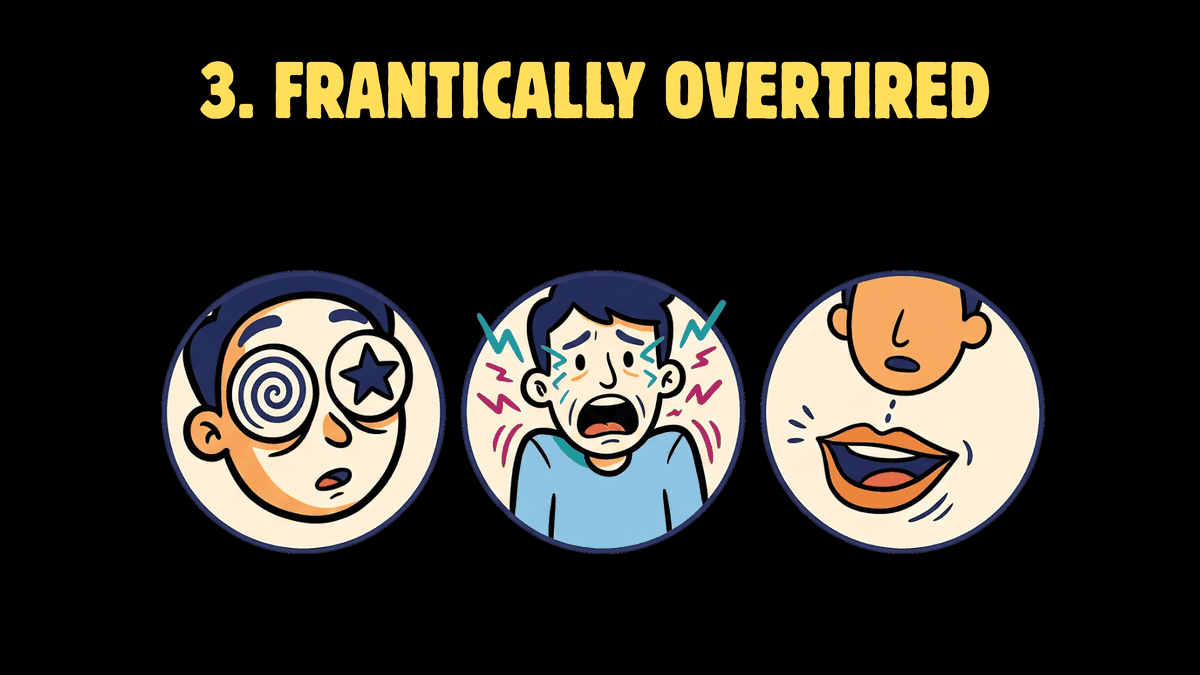
- The eyes are intense and fixated — Overtiredness or fear can create intense body movements and voice. Which would seem strange given the person has little energy. However, when we think about the fact that the fear response involves staring fixatedly in one direction (the subject of the person's fear), it makes sense why a person who is lacking enough sleep can end up coming across as crazy. Their body has gone into a survival response.
- The shoulders, face, and body are tense — Tension, or rather unnecessary tension, is the root of a lot of voice issues. When we tense up this means that our body is essentially fighting against itself to produce the voice because tension is associated with survival responses. This is a time when we don't usually produce well-balanced speaking because that's not what our body wants to do. It wants to fight, flight, or freeze.
- The mouth moves frantically without the help of the brain — I need to check my Neuroscience of the Voice notes for this one. But, as far as I remember, the mechanisms that produce the motions of speech are different from those involved in making our words make sense. This might be why we can blabber uncontrollably when we lack energy resources… but as I say I need to check my research again to verify this one.
4. Surprisingly Random
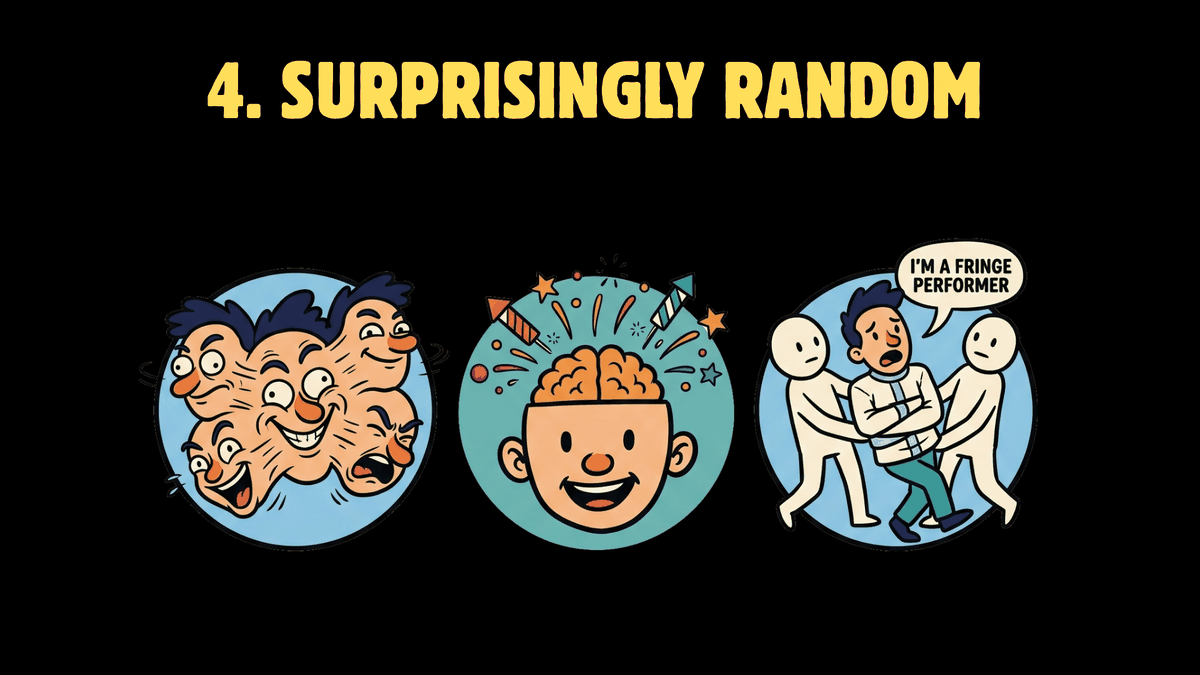
- Vocal qualities are varied and all over the place — There are a huge number of different vocal qualities and sounds that the human body can create. Someone who can access these has an almost endless supply of directions that they can use to create a voice that has an impact, ranging from the most annoying to the most surprisingly exciting.
- The creative brain is sparking with energy — Curiosity and play are huge parts of how I incorporate voice into my work, given I have a background as a clown. When my voice is the most free and playful, these are also the times when I come up with more exciting ideas. This is one of the directions I'm interested in looking into and researching further with the connection of clown through vocal play.
- It becomes hard to tell if the speaker is highly talented or has gone over the edge — An area of research that I'm particularly passionate about is the intersection between what people consider “normal society rules” and the types of voice that people use in performance disciplines. For example, I'm currently running a study into the effects of neurodivergent masking on the voice in workplace communication environments. I always find it interesting that the types of behavior that people consider “crazy” within normal society are exactly those that they celebrate as the most entertaining and skilled when we put them on to a stage.
5. The Zombie
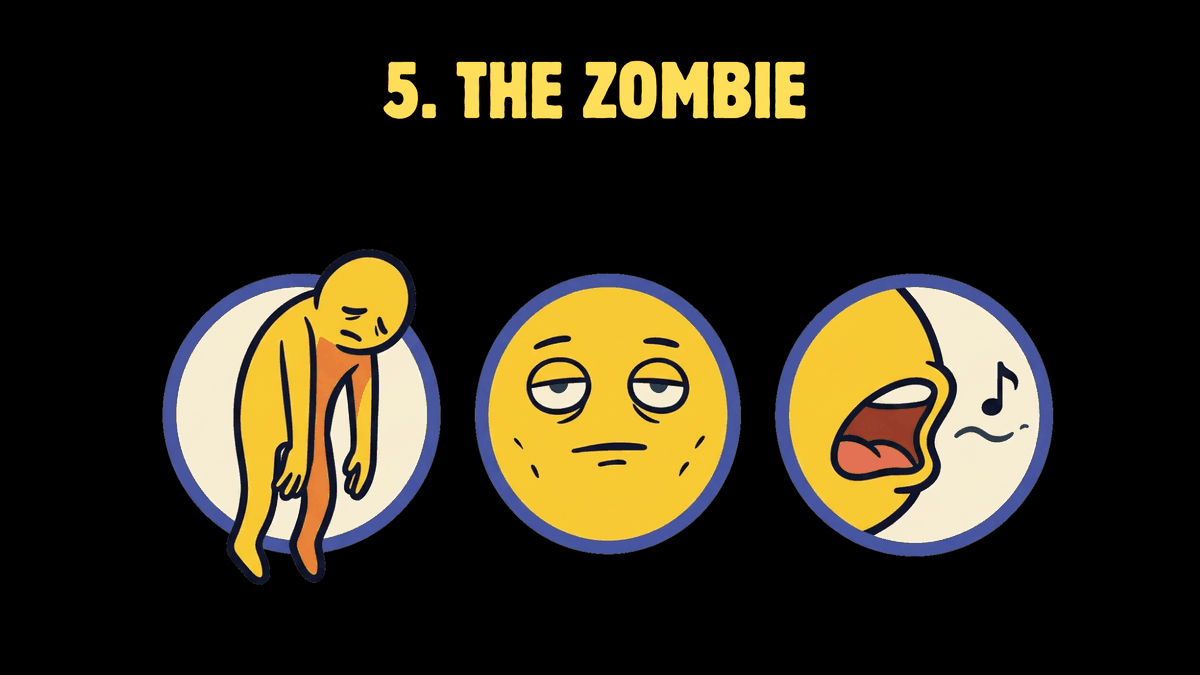
- The body is drained of energy and life — Energy and the voice are intricately linked. When we drain all energy from the body, the voice often goes with it. Sometimes this can be a good thing, as in when we are resting. Though if we are drained of too much energy, as can happen in the Edinburgh Fringe, the body can become unbalanced and our voice can suffer as a result.
- The face takes a thousand-yard stare — As a long-time meditator, I'm intrigued by the link between meditation and the voice, particularly when it regards releasing tensions in the body. The postural technique that I use as a background to my voice teaching practice is the Alexander Technique, which is very much about “letting go of tension” rather than trying to “push that tension out” as we might in a sports massage. It's interesting that the stare of someone who we consider spaced out or blank is not very far away from the type of stare that we can get in meditation.
- The voice, if it exists, is quiet and monotonous — Lack of vocal energy and general energy in the body does tend to produce a voice that is very quiet and lacks dynamics. There's nothing particularly wrong with this and sometimes it's a necessary part of vocal rest when we've hurt our voice. For communicating though, it falls within the category of “first-circle energy” in that the energy is inward towards the speaker rather than being outward towards the audience.
If you're interested in my research or you're a performer and you want help with your voice then check out FringeVoiceThing.com
 My free voice programme for Fringe performers